


Quick Summary
Waste handling follows a ranked order, where prevention and reuse sit above material recovery, energy recovery, and finally disposal. Each tier costs less to operate than the one below it, since avoided material carries no collection or tipping fee while recovered material generates value instead of expense. Recycling and composting together account for roughly a third of national volume, energy recovery captures usable power from what cannot be recycled, and engineered landfills handle the remainder under strict regulatory oversight. Climbing one tier at a time delivers more reliable results than attempting a full overhaul.
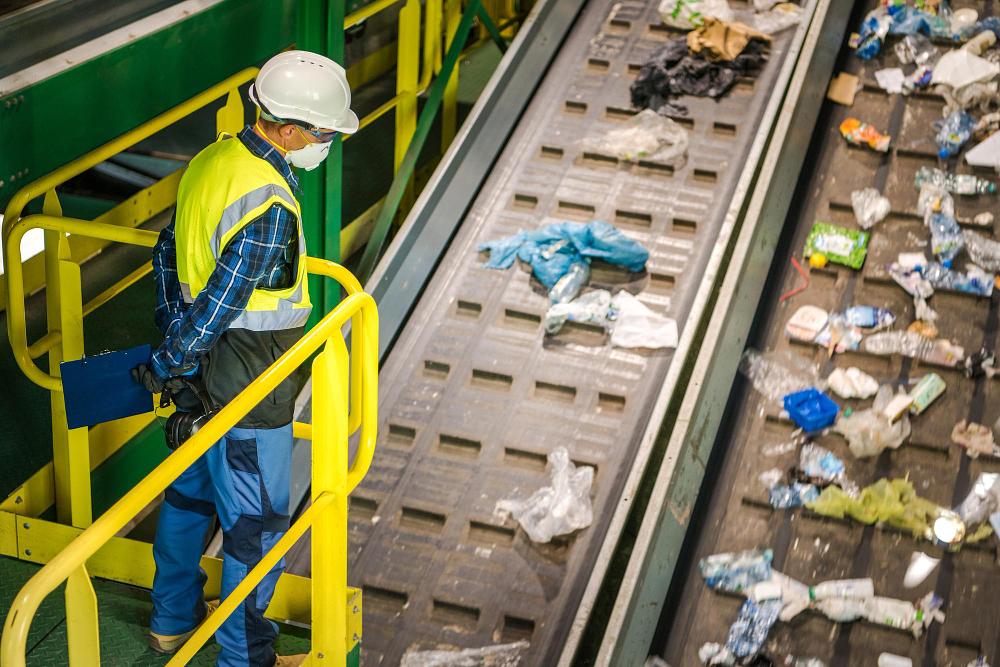
Every operation produces waste, though few people stop to ask what happens after the truck pulls away. The scale involved is easy to underestimate, since the United States generates hundreds of millions of tons of municipal solid waste in a single year, which works out to roughly five pounds per person every day. Handling that flow calls for more than one approach, and the Environmental Protection Agency built its guidance around exactly that reality, noting that no single method suits every material or every situation. What arrives at a grocery store loading dock has little in common with what leaves a demolition site. The main types of waste management each developed to answer a different piece of that puzzle.
Let's start at the very top.
Source Reduction and Reuse
- Cutting Waste Before It Exists
Nothing beats material that never enters your stream in the first place. Prevention sits at the very top of the federal hierarchy for a simple reason, which is that unproduced waste carries no collection cost, no processing cost, and no disposal fee at any point. Purchasing decisions drive most of the gains here. Buying in bulk rather than individual portions strips out layers of packaging before they ever reach your dock, and switching suppliers toward products designed with less material achieves the same result upstream.
Operational changes matter just as much as procurement does. Reusable shipping containers replace single-use cartons on repeat routes, while digital documentation removes paper from processes that never truly needed it. Equipment maintenance belongs in this conversation too, since a machine kept in good condition avoids becoming a disposal problem years earlier than it should.
- Extending Product Life
Keeping items in service represents the second half of this tier and works on a different principle entirely. Repair sits at the simplest end of that spectrum. A conveyor with a worn belt, a baler with a failing cylinder, or a forklift with a tired hydraulic system all continue earning their keep once someone addresses the specific fault rather than replacing the entire unit.
Refurbishment goes further by restoring equipment to a condition close to its original specification. Structural components get inspected, wear parts get replaced, hydraulics get rebuilt, and the finished machine returns to a production floor with years of service left in it. Remanufacturing takes the concept to its logical end, where a unit gets stripped to its core and rebuilt with updated components.
Industrial settings favor this approach because heavy equipment holds enormous embedded value in its steel, its castings, and its original engineering.
Recycling And Composting
- Recovering Materials for Manufacturing
Turning discarded material back into raw feedstock forms the backbone of resource recovery worldwide. The process runs as a chain rather than a single action. Collection gathers material from homes and businesses, sorting separates it into clean commodity streams, processing converts those streams into usable input, and manufacturing turns that input into new products.
A final link often goes unmentioned, which is consumer demand for goods containing recycled content. Without buyers at that end, the entire chain loses its economics. Scale here runs large, with roughly 69 million tons of material recovered annually across the country according to federal figures. Paper and paperboard dominate that total by a wide margin, followed by metals, then glass, plastic, and wood in smaller shares.
Contamination remains the constant threat throughout, since a single stream carrying the wrong material loses value quickly and sometimes gets rejected outright at the mill.
- Returning Organics to the Soil
Food scraps and yard trimmings behave differently from paper or metal, so they follow a separate path. Biological decomposition does the work here instead of mechanical processing. Composting exposes organic material to oxygen, moisture, and microbial activity until it breaks down into a stable soil amendment suitable for agriculture and landscaping.
Volume in this category runs higher than most operators expect. Federal data places composted material around 25 million tons annually, with yard trimmings accounting for the large majority of that figure and food waste trailing well behind.
Anaerobic digestion offers a second route for organics, where material breaks down without oxygen inside a sealed vessel and produces biogas alongside a nutrient-rich residual. Commercial kitchens, grocery operations, and food processors generate the most consistent organic volume, which makes them the strongest candidates for dedicated collection programs separate from their general waste.
3. Energy Recovery
- Converting Waste into Power
Material that cannot be recycled still holds usable energy inside it. Recovery captures that value rather than surrendering it to a landfill. Combustion represents the most established route, where waste burns at high temperature and the resulting heat drives a steam turbine to produce electricity for the grid.
Several other processes achieve similar outcomes through different chemistry. Gasification converts material into a synthetic fuel gas under limited oxygen, while pyrolysis applies heat in the absence of oxygen entirely to yield oil, gas, and char.
Scale nationally sits near 35 million tons handled this way each year, which represents roughly twelve percent of everything generated. An honest account includes what remains afterward, since around ten percent of the original volume survives as ash and travels to a landfill regardless.
- Capturing Gas from Existing Sites
Landfills continue producing energy long after their final load arrives. Organic material buried underground decomposes without oxygen and releases methane steadily over decades as a result. Left alone, that gas escapes into the atmosphere, where it carries far greater warming potential than carbon dioxide does.
Collection systems change that outcome entirely. Wells drilled into the waste mass draw the gas through a piping network toward a central point, where operators either flare it or route it toward productive use.
Applications vary by site and by local demand. Some facilities burn the gas onsite to generate electricity, others clean it to pipeline quality and inject it into the natural gas grid, and a few pipe it directly to nearby industrial users as a direct fuel source. Recovery projects like these turn a closed site into a working asset for years.
4. Treatment and Disposal
- Treating Waste Before Disposal
Some material requires intervention before anyone can safely bury it. Treatment reduces volume, toxicity, or both, and the methods fall into three broad families. Physical approaches change the form of the material without altering its chemistry, and shredding provides the clearest example of that principle at work.
Chemical treatment alters the substance itself, whether through incineration, neutralization of corrosive material, or stabilization of compounds that would otherwise migrate through soil. Biological methods rely on living organisms to break material down, with anaerobic digestion serving in this role as well as an energy recovery function.
Hazardous streams sit under separate federal regulation entirely and demand documented handling from the point of generation onward. Medical waste, solvents, batteries, and certain industrial byproducts all fall into that category and carry legal obligations that ordinary commercial waste never triggers.
- Engineered Modern Landfills
Burial ranks last among the available options, though the facilities themselves bear little resemblance to the open dumps they replaced. Contemporary sites operate under strict federal and state oversight covering their location, their design, their daily operation, and their long-term monitoring after closure.
Engineering underpins the whole structure. Composite liners of clay and synthetic membrane separate waste from the groundwater below, while leachate collection systems capture liquid draining through the mass and route it toward treatment.
Progress here has been substantial over several decades. Landfilling once absorbed roughly 94 percent of everything generated nationally in 1960, and that share has fallen to around half today as recovery methods expanded. Half remains a large figure, which explains why the tiers above this one attract so much attention. Disposal will always play a role, though the volume reaching it continues to shrink as operations move upward through the hierarchy.
Moving Your Operation Up the Hierarchy
The order of these tiers carries a practical message rather than a moral one. Waste handled higher up costs less over time, since prevention avoids fees entirely and recovery turns material into revenue instead of expense. Most operations already sit somewhere on this ladder without having chosen the position deliberately, and the useful question is which single tier above the current one is realistically within reach. Progress rarely arrives through a complete overhaul. It comes from capturing one stream properly, then the next.
Equipment usually determines how far an operation can climb. We supply balers, compactors, shredders, conveyors, and complete sorting systems in new, used, and refurbished condition, along with the baling wire that keeps recovered material moving out the door. Facilities pursuing serious recovery gains often start with our single-stream sorting solutions or a custom system designed around their specific material mix. Our consulting team also helps municipalities and commercial operators plan waste flow from the ground up, while our service technicians handle installation, preventive maintenance, and repairs afterward.
Contact us today and let's map out where your operation can climb next.
FAQs
Which type of waste management is the most cost-effective?
Prevention wins on cost every time. Material that never enters your stream carries no collection charge, no processing expense, and no tipping fee at the landfill. Recycling ranks next, since recovered commodities generate revenue rather than cost. Disposal sits at the bottom, where you pay for every ton without any return.
Is waste-to-energy the same thing as incineration?
Combustion forms one part of energy recovery, though the category covers more ground. Gasification, pyrolysis, anaerobic digestion, and landfill gas capture all convert waste into usable heat, electricity, or fuel through different processes. The defining feature is energy capture, which separates modern recovery facilities from older incinerators that simply burned material.
How can a business start moving up the waste hierarchy?
Begin with a waste audit to identify what actually fills your containers. Most operations discover one or two dominant streams, often cardboard or organics, that can be separated and recovered immediately. Equipment such as a baler or compactor usually pays for itself through reduced hauling and commodity sales within a few years.