


Quick Summary
A cardboard baler compresses loose corrugated into dense, uniform bales that are easier to store, transport, and sell to paper mills. Grocery stores, warehouses, and distribution centers use them to cut hauling costs, reclaim floor space, and earn revenue from material they would otherwise pay to discard. Vertical and horizontal models suit very different volumes.
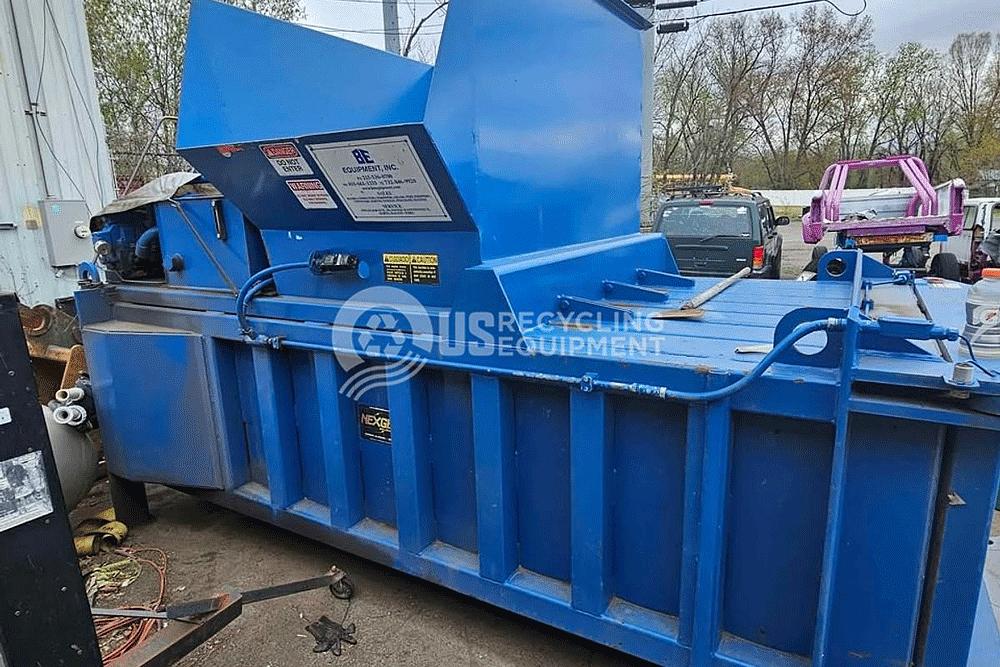
For any business that handles a steady stream of packaging, a cardboard bale quickly becomes one of the most valuable pieces of equipment on the floor. Grocery stores, distribution centers, manufacturing plants, and retail warehouses all generate significant volumes of corrugated cardboard every day, and without a way to manage it efficiently, that cardboard piles up fast, consuming labor hours and valuable square footage.
We work with facilities across a wide range of industries to help them select the right baler for their specific volume and operational needs.
How a Cardboard Baler Works
A baler operates by feeding loose cardboard into a chamber, where a hydraulic ram compresses the material under significant pressure. Once the chamber is full and the material has been compacted, an operator ties off the compressed block using wire to form a cardboard bale. The result is a dense, uniform block of material that is far easier to handle, stack, and transport than loose boxes and packaging.
This process of baling cardboard solves several problems at once. Loose cardboard takes up enormous amounts of space relative to its weight, and stacking loose boxes creates a fire hazard and a general safety concern in busy warehouse environments. By compressing that material into a compact, secured bale, businesses reduce their storage footprint dramatically while also making the material safer to move with a forklift.
Vertical Vs. Horizontal Balers
Not every business needs the same type of baler, and choosing the right one depends heavily on volume and available space. Vertical, or downstroke, balers are better suited to smaller operations with lower cardboard volume, such as a single retail location or a small distribution point. These machines are compact, require less floor space, and are generally simpler to operate, though they do require manual loading between cycles.
Horizontal balers, on the other hand, are designed for high-volume operations that generate cardboard continuously throughout the day. These machines are often fed automatically or semi-automatically through a conveyor system, allowing them to process much larger quantities of material with far less manual labor.
Distribution centers, large retail chains, and manufacturing facilities with consistent cardboard output tend to benefit most from a horizontal system, since it can keep pace with production without requiring an operator to stop and reload constantly.
Why Businesses Invest in Balers
The primary reason businesses invest in a baler is financial. Hauling loose cardboard away in a dumpster is a pure expense, since the business pays for pickup and disposal without recovering any value from the material itself.
A bale of cardboard, by contrast, has real market value to paper mills and recyclers, and many balers can pay for themselves over time through the revenue generated by selling baled material instead of paying to have it hauled away.
Beyond the financial upside, balers reduce the number of dumpster pickups a facility requires, since compacted material takes up a fraction of the space that loose cardboard does. This translates directly into fewer hauling fees and less time spent managing overflowing bins.
Facilities also see safety improvements, since baled cardboard eliminates the tripping hazards and fire risks associated with loose piles of packaging material stacked near work areas.
Choosing the Right Baler for Your Facility
Selecting the correct baler requires an honest assessment of daily cardboard volume, available floor space, and labor availability. A facility generating a few bins of cardboard per week has very different needs than one processing dozens of pallets of packaging daily, and choosing equipment sized incorrectly for actual volume often leads to bottlenecks or wasted capital.
At US Recycling Equipment, our team brings years of hands-on plant operation experience to every equipment recommendation we make. Whether you need a compact vertical baler for a single location or a full horizontal system engineered for continuous high-volume processing, our engineering and custom fabrication background allows us to match the right equipment to your specific operation.
Ready to explore your options? Browse our full inventory of balers, give our sales team a call, or contact us and we will help you find the right fit for your facility, whether you are looking to buy, lease, or rent.
Frequently Asked Questions
What is the difference between a vertical and horizontal cardboard baler?
A vertical baler is compact and better suited for lower-volume operations that can pause between manual loading cycles, while a horizontal baler is designed for continuous, high-volume operations and can often be fed automatically. The right choice depends on how much cardboard your facility generates daily.
Can baled cardboard be sold?
Yes. Baled cardboard has real market value and is sold to paper mills or recycling brokers, which can offset or fully cover the cost of the baler over time. Loose cardboard, by comparison, generates no revenue and requires paid hauling service.
How much space does a cardboard baler save?
Baling can reduce the physical footprint of cardboard waste significantly compared to loose material, since compression removes the air pockets that make loose boxes bulky. This translates into fewer dumpster pickups and more usable floor space in a warehouse or retail environment.